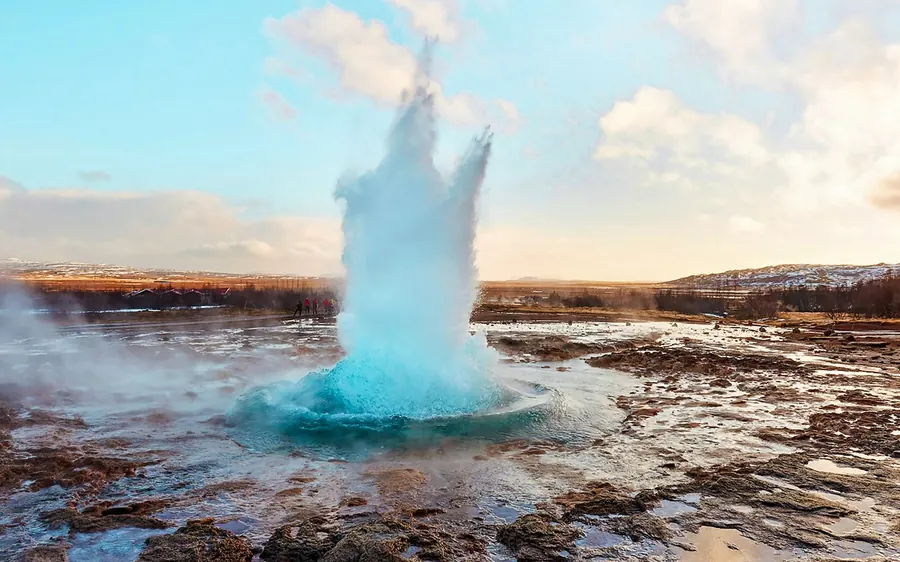
27,200 reviewsKerið included
7–8.5 hGolden Circle Full-Day Classic
★ 4.8 · 27200 reviews
- 7 to 8.5 hours, Iceland's Golden Circle
- Geysir area, Gullfoss waterfall
- Most booked
- Free cancellation
$86$10.75 / hour
Check availability→ Thirty-two metres, in two steps
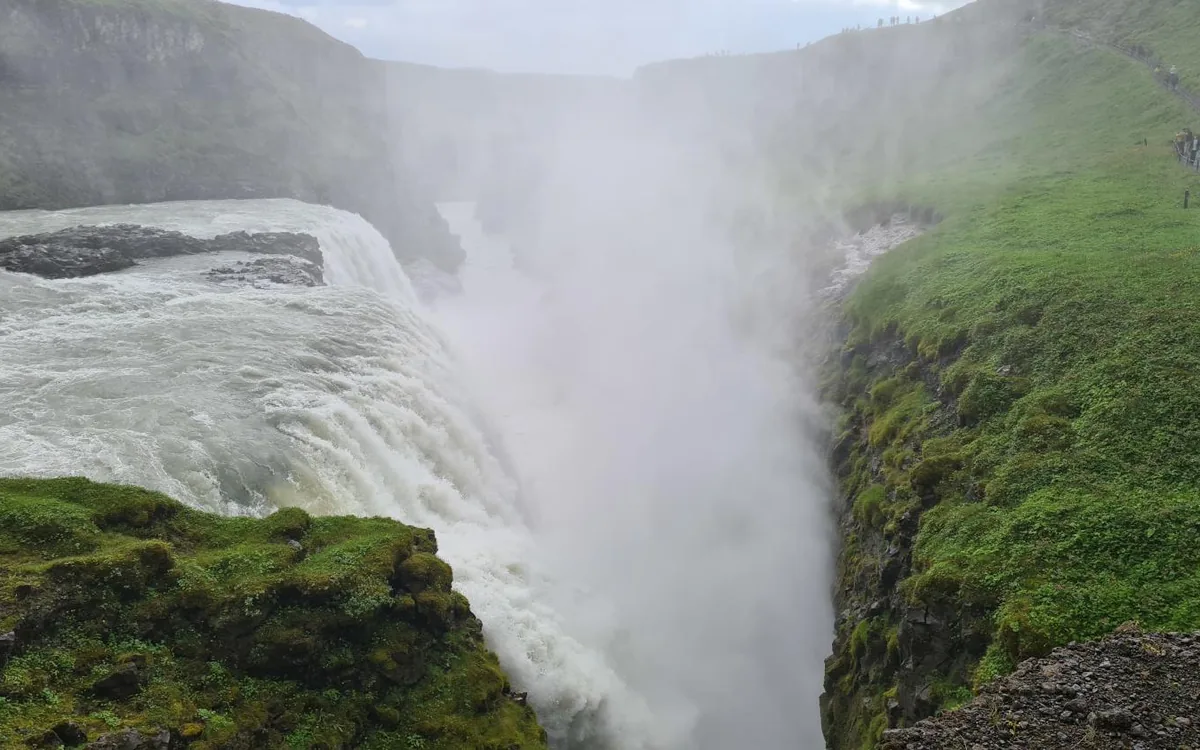
Gullfoss is the reason most people book a Golden Circle tour, and it is the stop nobody is ready for. The Hvítá — the White River, milky with rock flour off Langjökull — crosses a flat plain, drops eleven metres, turns ninety degrees and drops another twenty-one straight into a crevice about twenty metres wide and two and a half kilometres long. In summer it does that at around a hundred and forty-one cubic metres a second. It is free to visit and free to park.
Quick answer
The short answer. Free entry, free parking, two car parks. Two drops of 11 and 21 metres, 32 in total, into a canyon 2.5 km long. Busiest between eleven and two when the coach convoy arrives — go before or after and it is a different place. Take a waterproof: the spray reaches the upper path.
What you are looking at
The second drop vanishes into a slot in the ground. That is the whole trick, and no camera gets it.
The thing that makes Gullfoss strange, and hard to photograph, is the geometry.
Most big waterfalls drop off a straight edge and you look at them from the front. Gullfoss does not. The Hvítá runs across an open plain, falls eleven metres over a step, turns almost ninety degrees, and then falls another twenty-one into a crevice that runs away from you at an angle. From the upper viewing path the second drop disappears into the ground and you cannot see the bottom of it at all.
That crevice is about twenty metres wide and two and a half kilometres long, and it was cut by glacial floods at the end of the last ice age. The water going into it in summer is roughly a hundred and forty-one cubic metres every second.
Which is why the standing joke about Gullfoss is true: photographs of it are always disappointing, and nobody who has stood there is surprised by that.
Sigríður
There is a memorial stone above the falls with a woman’s profile carved into it, and most people walk past it.
In the first half of the twentieth century, foreign investors leased Gullfoss with the intention of damming it for hydroelectric power. Sigríður Tómasdóttir, daughter of the waterfall’s co-owner, campaigned against it — she is said to have walked to Reykjavík to argue the case, and to have threatened to throw herself into the falls if the scheme went ahead.
The dam was never built. Gullfoss was designated a permanent conservation site in 1979, and the stone went up in her name.
It is a good thing to know before you arrive, because it changes what you are looking at. This is not a waterfall that was always going to survive.
Visiting
Everything here is free. These are the details that make the stop better.
The upper car park has the visitor centre and the classic view down the length of the canyon. The lower one puts you on the path that runs out towards the lip. Do both if you have an hour; do the upper one if you have twenty minutes.
Spray from the second drop reaches the paths, and the wind here will destroy an umbrella within a minute. A hood is the answer.
The coach convoy leaves Reykjavík between eight and nine and reaches Gullfoss late morning. Either side of that window the car parks are half empty.
Ice makes the steps down genuinely dangerous and they are roped off in the cold months. The upper viewpoint stays open and is still worth the drive.
Both at the upper car park. Beyond Gullfoss the road to the highlands has neither.
Flow drops to about eighty cubic metres a second and the edges freeze into ice shelves. Less power, much more strangeness.
Gullfoss is stop three. The other two are ninety minutes behind you.
Þingvellir and Geysir→Book direct
Every tour on this site includes it. These four are the ones people book most.
★ 4.8 · 27200 reviews
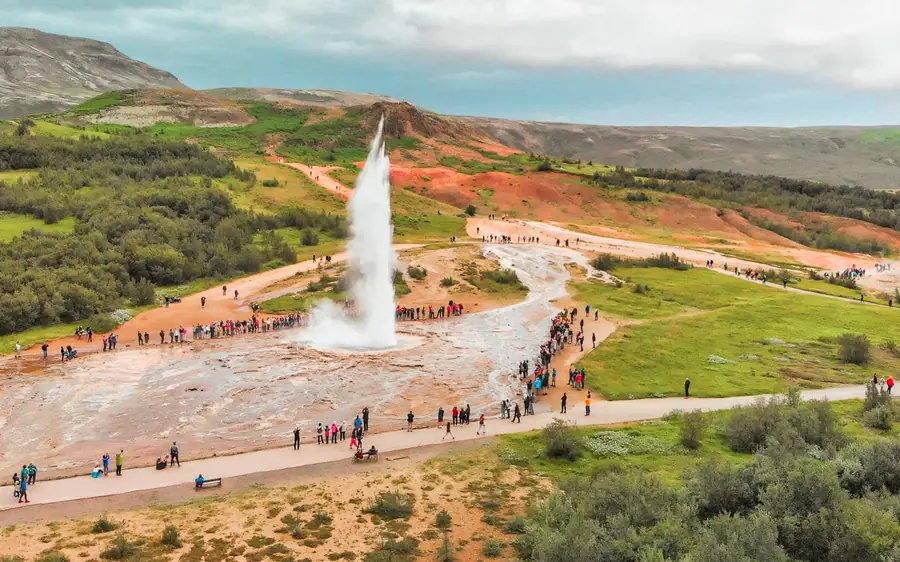
★ 4.8 · 801 reviews
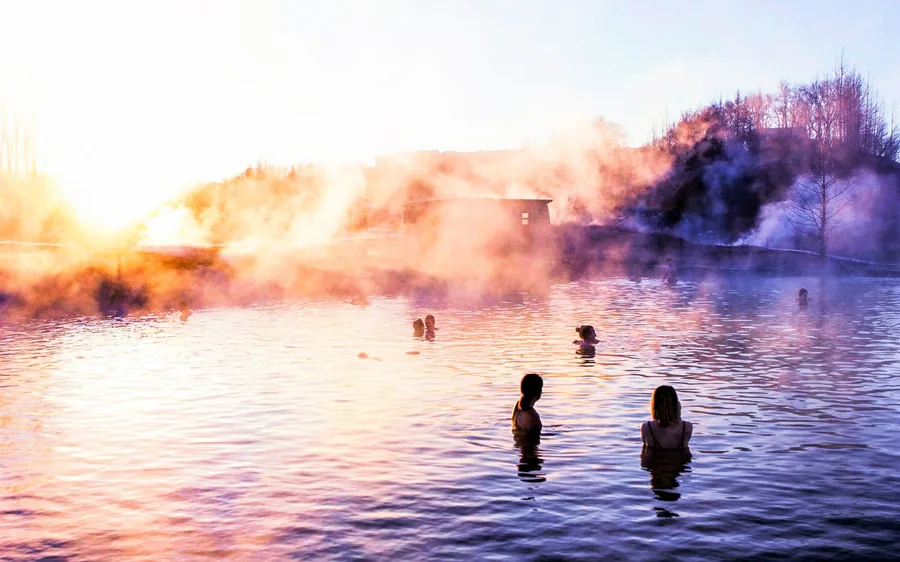
★ 4.8 · 6446 reviews
★ 4.9 · 173 reviews
Common questions
Thirty-two metres in total, in two steps: an eleven-metre drop and then a twenty-one-metre one. The second falls into a crevice about twenty metres wide and two and a half kilometres long, which is why it looks as though the water is disappearing into the ground.
Yes, and the parking is free too — the only one of the three main Golden Circle stops where it is. There is no ticket, no gate and no booking.
About 120 kilometres, or roughly an hour and forty minutes each way, as the last of the three main stops on the loop.
About 141 cubic metres a second in summer and 80 in winter. The river is the Hvítá, which carries meltwater and fine rock flour off the Langjökull ice cap — that is what makes it white.
Sigríður Tómasdóttir, daughter of the waterfall’s co-owner, is credited with stopping a hydroelectric scheme in the first half of the twentieth century. There is a memorial stone with her profile above the falls, and Gullfoss has been permanently protected since 1979.
Yes. The upper viewpoint stays open all year and the falls partly freeze, which is worth seeing in its own right. The lower path is usually roped off because of ice.
Go deeper
The three headline sites and the six worth adding, with what each one costs.
Kerið270 metres across, 55 deep, and the only stop on the route with a gate fee.
The other twoA rift between two continents, and the geyser that is asleep next to the one that is not.
Route230 km, which roads, which direction, and every car park with its fee.
ItineraryHour by hour from Reykjavík and back, in the order that misses the coaches.
PricesTwelve tours priced against each other and against driving it yourself.
3-Day Golden Circle & South Coast
★ 4.9 · 646 reviews · Free cancellation 24 h