November
Getting dark
Six to seven hours of light at the start of the month, five by the end. Roads generally fine, waterfall still strong, and prices dropping. The most workable of the winter months.
Four hours of light
The Golden Circle runs every day of the year and the roads are cleared as a priority — this is the main tourist route out of the capital and Iceland treats it that way. What changes in winter is not access but time: four to six hours of usable daylight in December, and a wind that closes roads with a couple of hours’ notice. Both of those change the answer to whether you should drive it yourself.
Quick answer
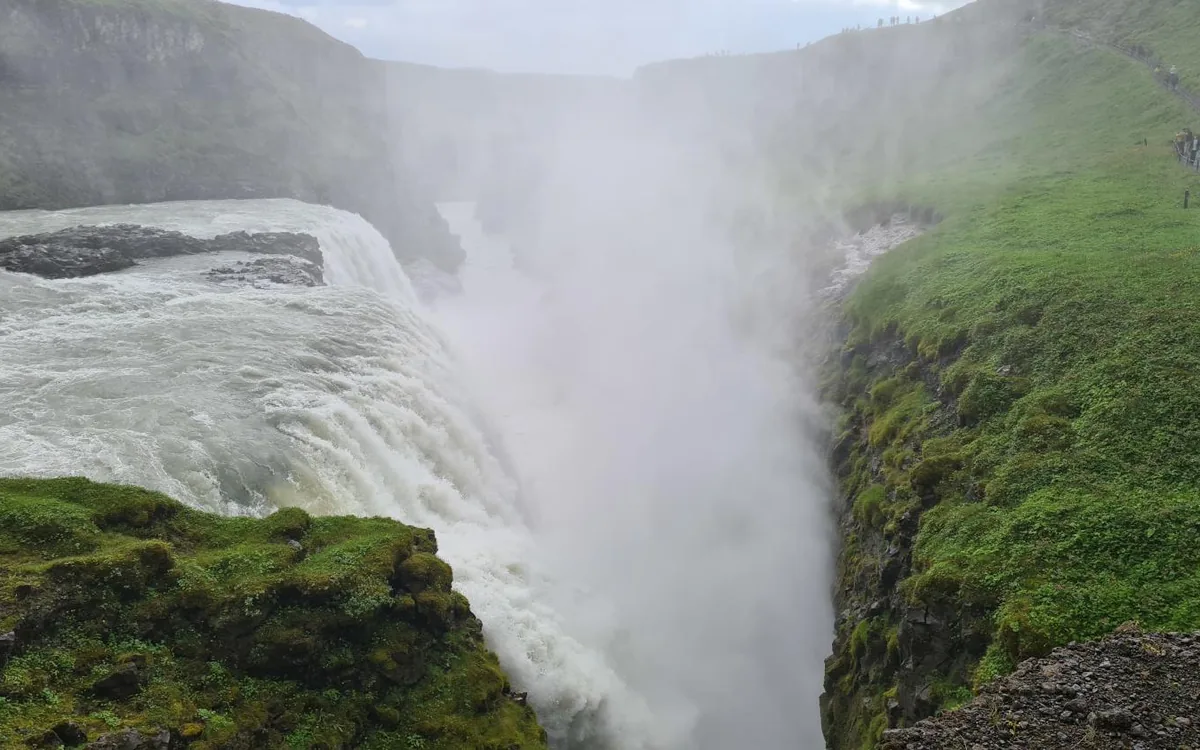
The short answer. Take a tour. In December you have about four hours of light and the loop needs six to eight, so a self-drive means arriving at Gullfoss in the dark. A tour compresses the same three stops into the daylight and somebody else watches the wind forecast. Gullfoss part-frozen is worth the trip on its own.
Daylight is the whole problem
The loop does not shrink in December. The daylight does. That is the whole argument.
In late December, Reykjavík gets somewhere around four to five hours of usable daylight — the sun comes up around eleven and is gone by half past three, and for a good part of that it is very low.
The Golden Circle loop takes six to eight hours with stops. The arithmetic is obvious and people still get caught by it: leave at ten, and Gullfoss happens in the dark.
A guided tour solves this by compressing. Departures leave earlier than you would, the stops are shorter and fixed, and the driving between them happens in the dark at each end of the day, which is exactly where you want the darkness to be. The three stops themselves land inside the light.
It also means somebody else is doing the driving on the bit of the day that is genuinely unpleasant: the run home in the dark, in wind, on a road you do not know.
Wind, not snow
Visitors arrive expecting snow to be the hazard. It is not, usually. Snow gets cleared, and these are the priority roads.
What closes roads in Iceland is wind. Gusts that pick up gravel, take doors off hire cars, and make a high-sided vehicle undrivable. It arrives fast and it is forecast well — which is why every Icelander checks road.is and vedur.is before setting off, every time, and why you should too.
The practical consequence for a visitor is this: a closed road is not a delay you drive around. There is one road to Þingvellir and one loop. If it shuts, the day is over, and a guided tour is refunded while a hire car is not.
Winter specifics
The route is the same. Almost everything around it is not.
Flow drops to about eighty cubic metres a second from a hundred and forty-one, and the edges freeze into shelves and columns. Less raw power, much more strangeness, and the spray freezes on the railings.
Ice on the steps makes it genuinely dangerous and it is closed most of the winter. The upper viewpoint stays open and is still the better view.
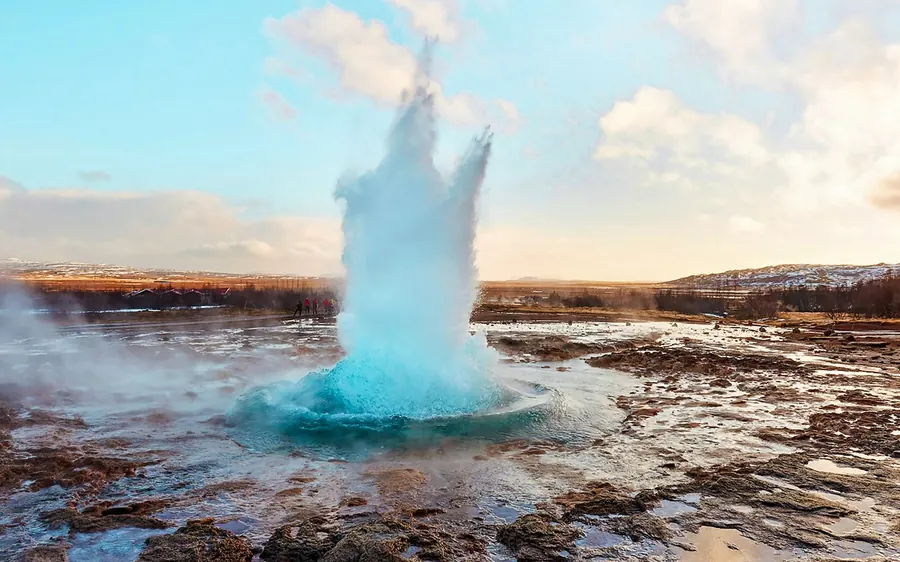
It erupts every six to ten minutes in January exactly as it does in July, and the steam against cold air is more dramatic. This is the one stop winter improves outright.
The lake ices and the snow picks out the layers in the crater walls. The steps down are sometimes closed; the rim path stays open.
Not for the tracks — for the car parks and the paths at Gullfoss, which turn into sheet ice. It is a small thing that makes the whole day easier.
Some winter Golden Circle tours end late enough to look for them, and some sell that as a feature. Treat it as luck. If aurora is the reason for your trip, book a dedicated night tour instead.
The cold months
Ranked on whether the day works, not on temperature.
November
Six to seven hours of light at the start of the month, five by the end. Roads generally fine, waterfall still strong, and prices dropping. The most workable of the winter months.
December
Four to five hours of usable light. A self-drive loop does not fit; a tour does. Christmas markets in Reykjavík and a genuinely low sun that never gets far above the horizon.
January
Light returning slowly, and the month most likely to have a road closed by wind. Gullfoss at its most frozen. Book a tour and keep a spare day.
Feb – Mar
Daylight back past nine and then twelve hours, snow still on everything, and the crowds not yet arrived. The best of the cold months, and the one we would pick.
Whichever month you come, this is what each stop costs to enter.
Every stop on the loop→Book direct
A guided loop, a hot pool, an ice cave and an ice cap.
★ 4.8 · 27200 reviews
★ 4.8 · 6446 reviews
★ 4.7 · 95 reviews
★ 4.6 · 319 reviews
Common questions
Yes, every day of the year — these are priority roads and they are cleared. The constraint is daylight: four to six hours in December against a loop that takes six to eight, which is why a guided tour makes more sense in winter than at any other time.
With winter tyres, which every Icelandic hire car has by law, and with the forecast checked, yes for confident drivers. The real hazard is wind rather than snow, and it closes roads at short notice. Check road.is and vedur.is on the morning, every time.
Smaller and stranger. Flow drops from about 141 cubic metres a second to 80, and the edges freeze into shelves and columns with the spray icing on the railings. The lower path is usually closed.
Yes, every six to ten minutes, exactly as in summer. The steam against cold air makes it more dramatic, not less. It is the one stop that winter improves.
Occasionally, on tours that finish after dark, and some sell it as a possible extra. Treat it as luck. If the aurora is the reason for your trip, book a dedicated night tour.
February or March. Daylight is back past nine and then twelve hours, snow is still on everything, and the summer crowds have not arrived. December has the shortest days and January the highest chance of a road closed by wind.
Go deeper
The three headline sites and the six worth adding, with what each one costs.
GullfossTwo drops, 32 metres, 141 cubic metres a second, and the woman who saved it.
Kerið270 metres across, 55 deep, and the only stop on the route with a gate fee.
The other twoA rift between two continents, and the geyser that is asleep next to the one that is not.
Route230 km, which roads, which direction, and every car park with its fee.
ItineraryHour by hour from Reykjavík and back, in the order that misses the coaches.
3-Day Golden Circle & South Coast
★ 4.9 · 646 reviews · Free cancellation 24 h